Robotic Process Automation (RPA)
RPA saves time and minimizes errors by automating repetitive operational tasks performed by humans. As Seytek Bilişim, we offer end-to-end RPA solutions to accelerate your operations.
RPA Services We Offer
Entrust your business processes to digital workers with software robots
Process Analysis
We analyze your processes best suited for automation and prepare efficiency-oriented design and feasibility reports.
Robot Development
Using leading RPA platforms, we transform your business workflows into autonomously operating digital robots.
System Integration
We develop robots that communicate flawlessly with ERP, CRM, and web applications to transfer data between systems.
Monitoring & Maintenance
We ensure the continuity of your robots and improve processes by monitoring their performance 24/7.
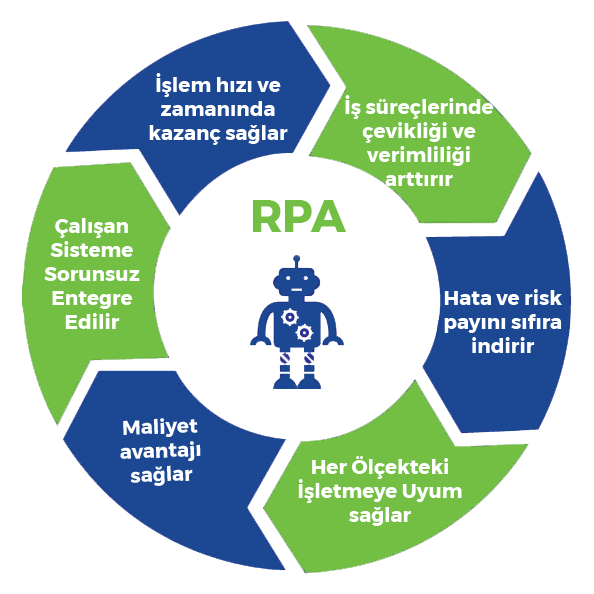
Why RPA?
Core benefits of a digital workforce for your business.
Contact us to increase your efficiency with RPA solutions.
Leave repetitive tasks to robots, focus on your strategy.
Who Is RPA For?
Robotic process automation fits organizations where teams spend hours each day on repetitive, rule-based work across several systems. It is relevant to both the departments doing that work and the managers accountable for its cost.
Finance and Accounting Teams
Teams that key invoices, reconcile statements and move figures between systems by hand on a fixed schedule.
Operations and Supply Chain
Departments that copy order, stock and shipment data between an ERP, supplier portals and internal spreadsheets.
Shared Service Teams
Back-office units handling high volumes of standard requests where accuracy and turnaround time are measured.
IT and Systems Managers
Managers asked to connect applications that have no ready integration, and who must keep robots monitored and maintained.
Growing Mid-Sized Companies
Companies whose transaction volume is rising faster than headcount and that want existing systems kept in place.
How We Work
An RPA project starts with the process itself, not the software. We work through four stages, from assessing which tasks are worth automating to keeping the robots running afterwards.
Process Analysis
We map the candidate process step by step, record the systems, screens and rules involved, and set out in a feasibility report which steps a robot can take over.
Design and Build
We agree the target workflow with the people who run it, then develop the robot on an established RPA platform, including its exception and error paths.
System Integration and Testing
We connect the robot to the ERP, CRM and web applications it needs, then test it against real cases until its output matches what your team produces by hand.
Go-Live and Monitoring
We put the robot into production, hand over the operating instructions, and monitor its runs so failures are caught and the process can be adjusted as it changes.
Frequently Asked Questions
What is robotic process automation, in practical terms?
Robotic process automation uses software robots to carry out rule-based tasks the way a person would: opening applications, reading data, filling fields and moving records between systems. The robot follows the steps you define, so the underlying applications do not have to be replaced or modified. It suits work that is repetitive, high in volume and based on clear rules.
Which processes are the best candidates for process automation?
Tasks that follow the same rules every time, run often, use structured data and touch more than one system are the usual starting points. Work that requires judgement on every case, or that changes shape constantly, is a poor fit. The process analysis stage exists to separate the two before any development begins.
Do we need to change our existing ERP or other software?
No. Robots work through the same interfaces your staff use, and can also connect through APIs or web services where those are available. That is one reason RPA is often chosen for systems that are difficult or costly to modify. Any integration approach is decided during analysis, based on what each application supports.
How long does an RPA project take?
It depends on how many steps the process has, how many systems it touches and how clean the underlying data is. A single, well-defined task is a much shorter piece of work than a chain of processes spanning several departments. We give a timeline after the process analysis, when the scope and the exception cases are actually known.
How is an RPA solution priced?
Pricing has two parts: the work of analyzing, building and testing the robot, and the licensing of the RPA platform it runs on. Both depend on the scope, so we do not quote a figure before the process has been examined. After the analysis you receive a defined scope with the cost attached, and you can decide whether to proceed.
What happens if a system changes and the robot stops working?
Screen layouts, field names and application updates do break robots, which is why monitoring and maintenance are part of the service rather than an afterthought. Run logs show where a robot stopped and why, so the cause can be traced quickly. The robot is then adjusted to the new version of the system and put back into service.