Software Development Solutions
In today's competitive environment, digitalization of processes has become a critical need for businesses. As Seytek Bilişim, we offer custom software solutions that accelerate your operations and increase efficiency.
What We Do?
Our technological expertise that drives your digital transformation
Enterprise Applications
We make your operations measurable with web and desktop applications developed specifically for your business processes.
Web & Mobile Apps
We create effective experiences for both employees and customers with modern, fast, and user-friendly interfaces.
API & Microservices
We build flexible, scalable, and secure integration structures that ensure different systems work in harmony.
Consultancy & DevOps
We provide long-lasting solutions for your projects with the right technology choice and sustainable strategies.
Why Seytek Bilişim?
Our development approaches that make a difference as your technology partner.
Contact us to digitalize your operations with custom software solutions.
Let's draw the most suitable technological roadmap for your needs together.
Who Is This For?
For companies where off the shelf software does not fit the way work actually happens, and processes still run on spreadsheets and manual steps. Teams that need an application shaped around their own requirements, one that talks to the systems they already use.
Companies with non standard processes
Businesses that cannot bend packaged software to their workflow and keep looking for external workarounds.
Businesses with disconnected systems
Organizations moving data by hand between ERP, e-commerce and field applications, in need of proper integration.
Teams working in the field
Warehouse, service and sales units that need mobile access outside the office.
Companies outgrowing an application
Teams whose software slows down as user count or transaction volume grows and needs restructuring.
Companies taking over a codebase
Businesses that parted ways with their developer and need a team to maintain the existing source code.
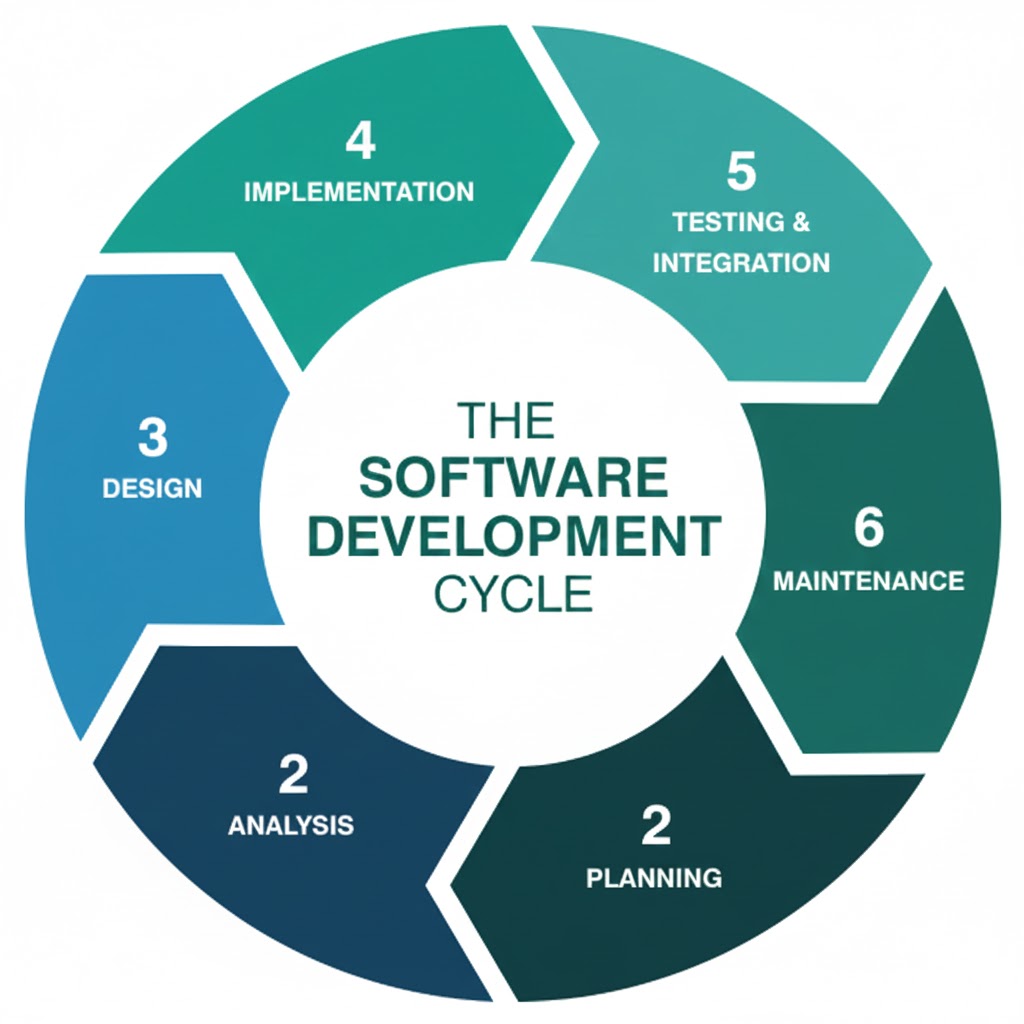
How We Work
We understand the process before writing code. A misunderstood requirement is the most expensive thing to correct once development is underway.
Process and requirement analysis
We observe how the work actually runs and agree together on which steps move into software and which stay outside it.
Architecture and integration plan
We define which systems the application will talk to, the direction of data flow and the API requirements. Expected scale shapes the architecture at this stage.
Incremental development
We deliver a working section early and collect feedback, so a wrong assumption surfaces at the start of the project rather than at the end.
Deployment and continuity
Release, user training and subsequent maintenance run from a single point. Source code and technical documentation are handed over to the company.
Frequently Asked Questions
How long does custom software development take?
Duration depends on process complexity and the number of systems involved. An application covering a single workflow is not comparable to a project connecting several systems. After requirement analysis we produce a schedule broken into work packages.
Why custom software instead of a packaged product?
Packaged software is faster and cheaper where your process is standard. Custom development makes sense when the part of the work that creates competitive advantage does not fit the package. During analysis we assess together which parts can stay in a package and which need building.
Can you integrate with our existing systems?
Systems exposing an API or web service are connected directly. For applications without such an interface, alternatives like database level access or file based transfer are evaluated. The suitable method depends on how the system is built.
Can web and mobile applications be built in one project?
Yes. Both interfaces can sit on a shared service layer, so business rules live in one place and the two platforms do not drift apart. Whether the mobile side becomes a separate application or a browser based interface depends on the usage scenario.
Will we own the source code?
Transfer of source code is defined explicitly in the project agreement. Code, database structure and technical documentation are handed over as part of delivery, so you are not locked in if you choose to work with another team later.
Do you provide support after launch?
Maintenance and support are defined as a separate scope covering bug fixing, version updates and development against new requirements. Support level and response times are agreed before the engagement begins.